Azorean Tea and Pineapple: From Farm to Plate
How are tea and pineapple actually used in São Miguel's food, not just grown for tourists?
Gorreana and Porto Formoso tea turns up in cakes, ice cream, liqueurs and everyday afternoon cups across the island, while greenhouse-grown pineapple from areas like Fajã de Baixo goes into jams, liqueurs, wine, desserts and savoury dishes in Ponta Delgada restaurants. Both are treated as everyday local produce, not novelty souvenirs.
How an island grows its own flavour
São Miguel is famous for two crops that shouldn’t, on paper, grow well in the middle of the North Atlantic: tea and pineapple. Both do, and both end up on the table in ways that have little to do with the plantation tour itself. This page is about the finished product — what’s in the cup, the jar, the glass and on the plate — not about walking the fields at Gorreana or the greenhouses of Fajã de Baixo.
For the visits themselves, see the Gorreana tea plantation guide, the Porto Formoso tea plantation guide, the pineapple greenhouses guide, or the comparison of which plantation to visit if time is short.
What makes both crops interesting as ingredients, rather than as attractions, is how ordinary they are here. Locals don’t treat Azorean tea and pineapple as souvenirs; they’re what’s in the cupboard. Understanding that everyday role changes how you eat and drink on the island — and what’s worth buying before you fly home.
Tea beyond the teapot: how the island’s leaves end up in food
Gorreana, founded in 1883, is the oldest working tea plantation in Europe — not the world, a distinction worth getting right, since older estates exist in Asia. Alongside the smaller, ticketed Porto Formoso estate, it’s one of only two working tea producers left on the European continent. Between them they supply most of the loose tea sold on São Miguel, in both green (Hyson-style) and black leaf, plus an orange-pekoe style black tea that’s become something of a house style for the island.
As a drink, Gorreana tea is simply what many island households serve in the afternoon, alongside or instead of coffee. It’s brewed plain, sometimes with a slice of lemon, rarely with milk in the mainland English style. You’ll find it on café menus in Ponta Delgada without any fanfare — it’s just “chá”, the local tea, next to the imported brands.
Where it gets more interesting as an ingredient is in baking and desserts. Tea-flavoured cake, tea-scented biscuits and green-tea ice cream turn up on menus and in bakery counters, particularly in Ponta Delgada and Ribeira Grande, using the plantations’ own leaves rather than imported matcha or bagged tea. Some pastry cooks steep the leaves into custards or glazes; a few restaurants use a light tea infusion in a sauce for pork or duck, playing on the same bitterness-and-sweetness balance the leaf gives a cup of black tea. None of this is standard on every menu — it’s worth asking directly whether a “chá” item on a dessert list uses Azorean leaf, since the answer is sometimes yes and sometimes just a flavouring.
Tea also shows up as a gift-shop and supermarket product in forms well beyond the loose leaf: tea-infused liqueurs, tea soaps and even tea-scented candles trade on the Gorreana name, though these have moved a long way from the kitchen. For cooking and drinking, the loose green and black leaf sold in tins at supermarkets and the Mercado da Graça in Ponta Delgada is the product worth focusing on — see the Mercado da Graça food market guide for where to find it.
Pineapple without a single open field
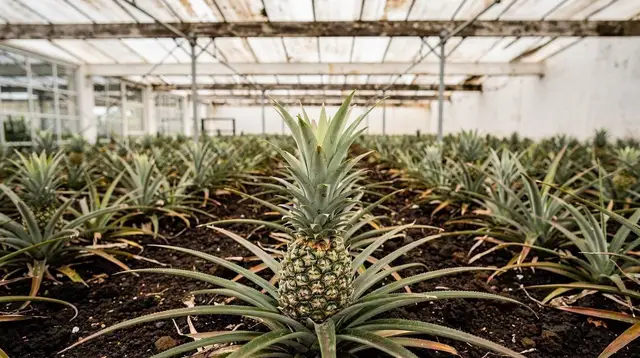
The single fact to hold onto about Azorean pineapple is that it doesn’t grow outdoors. The island’s cool, wet, cloud-prone climate is nothing like the tropical conditions pineapple needs, so growers put it under glass instead — low, whitewashed greenhouses (locally estufas) concentrated around Fajã de Baixo, just outside Ponta Delgada, with smaller pockets elsewhere on the island.
Inside, growers control heat, humidity and light by hand, in a method largely unchanged since the nineteenth century. A single fruit takes roughly two years from planting to ripeness — several times longer than open-field pineapple grown in the tropics, which is also why the São Miguel fruit is smaller, denser, sweeter and considerably more expensive than the pineapple sold in a mainland European supermarket.
That slow ripening under glass is the whole reason the fruit tastes different: less acidic, more floral, with a texture that holds up well in cooking rather than turning watery. Locally, that makes it as useful in savoury dishes as in dessert.
On the savoury side, pineapple appears alongside pork, in salads with local cheese, and as a garnish for grilled fish — a version of sweet-and-savoury pairing that owes more to Portuguese and Azorean cooking traditions than to any tropical influence. On the sweet side, expect pineapple jam, candied pineapple, pineapple cake and pineapple in queijada-style pastries sitting next to the more traditional bolo lêvedo and queijadas da Vila on a bakery counter.
Pineapple liqueur — a sweet, bright yellow drink served chilled as a digestif or mixed into a cocktail — is on drinks lists across Ponta Delgada, and pineapple wine, a fermented rather than distilled product, has become its own small local specialty. For a guided way to taste several of these side by side, the pineapple wine and fruit tasting below covers the drinking side of the crop without asking you to plan a separate greenhouse visit.
a guided pineapple wine and fruit tasting in Ponta Delgada is the simplest way to try several pineapple products in one sitting, from the fermented wine through to the liqueur and preserved fruit, with someone explaining what’s actually in the glass.
Where the two ingredients meet on a plate
Tea and pineapple rarely appear together in a single dish, but they do share a role on the island’s tables: both are treated as everyday local produce rather than luxury imports, and both are woven into meals that have nothing obviously tropical or Asian about them. A typical Ponta Delgada lunch might close with a slice of pineapple cake and a pot of Gorreana tea, the same way a mainland Portuguese lunch might close with a custard tart and a coffee — it’s substitution, not fusion.
The clearest place to see this in practice is around a big, slow-cooked meal like cozido das Furnas, where a heavy, meat-and-vegetable main is often followed by something lighter and fruit-forward, and a proper look at what people actually eat across the island is worth a read before committing to any one region’s food — see what locals actually eat on São Miguel. Restaurants near Furnas that build a menu around the cozido experience are worth booking ahead for exactly this reason; see where to eat near Furnas for the practicalities.
Seafood is the other place tea and pineapple both show up as accents rather than headline ingredients — a light tea-butter sauce on grilled fish, or pineapple worked into a salad alongside limpets and other Azorean shellfish. For a primer on the seafood itself, before you start layering fruit and tea into it, see lapas and Azorean seafood: what to try.
| Product | Typical form | Where you’ll meet it |
|---|---|---|
| Gorreana green tea | Loose leaf, brewed plain | Cafés, restaurants, supermarkets |
| Gorreana / Porto Formoso black tea | Loose leaf, orange-pekoe style | Cafés, tins for sale, hotel breakfasts |
| Tea-flavoured desserts | Cake, biscuits, ice cream | Bakeries in Ponta Delgada and Ribeira Grande |
| Fresh Azorean pineapple | Whole fruit, cut fruit | Markets, greengrocers, some menus |
| Pineapple jam / candied pineapple | Jar, small blocks | Supermarkets, gift counters, Mercado da Graça |
| Pineapple liqueur | Bottled spirit | Bars, restaurants, bottle shops |
| Pineapple wine | Bottled, fermented | Wine shops, tastings, some restaurants |
Buying tea and pineapple to take home
Of the two, tea is the far easier souvenir. Loose Gorreana or Porto Formoso tea packs flat, keeps for months without refrigeration, and clears airport security without a second look — a tin or two bought at the Mercado da Graça or any supermarket is the low-effort version of bringing the island home. Tea-based liqueurs and cosmetics travel the same way, if you want something beyond a simple leaf.
Fresh pineapple is a different proposition. A whole fruit is heavy, bulky, and — because of the two-year growing cycle — genuinely expensive compared to the imported pineapple most travellers are used to, so it’s rarely worth the suitcase space. Jam, candied pineapple and small bottles of liqueur or wine are the practical way to bring the flavour home instead, and all three are widely stocked in Ponta Delgada shops and at the market. If you’d rather eat the fresh fruit than pack it, that’s the better use of it anyway: buy it locally, eat it locally, and let jam or liqueur do the travelling.
Either way, factor tipping and VAT into what you spend at a café or restaurant trying these products — Azorean VAT sits below the mainland rate and a round-up is the normal tip, both covered in the tipping, VAT and restaurant etiquette guide. And because kitchens here lean on whatever is in season, a menu built around fresh local pineapple in September can look different by December — see eating with the seasons for what that means for booking ahead.
Tasting both without planning a plantation visit
If the plantations themselves aren’t on your itinerary, tea and pineapple are still easy to taste. Ponta Delgada’s cafés, restaurants and the covered Mercado da Graça put both in front of you without a drive out to Fajã de Baixo or the north coast tea fields, and a guided food or drink experience does the introducing for you. Alongside the pineapple wine tasting above, a longer day exploring the island’s caldera villages and gardens is a natural place to pick up both ingredients in context: the biologist-guided walk through Terra Nostra’s gardens touches on local plants and produce as part of its narrative, and a full island or east-coast day out typically stops somewhere selling both tea and pineapple products along the way.
a biologist-guided walk through the Terra Nostra gardens with lunch works well if you want the island’s produce explained as part of a wider look at its plants and volcanic soil, not just tasted in isolation.
a full day touring the island’s east coast with lunch included is a practical way to pass through tea and pineapple country without organising the stops yourself, ending the day with a proper Azorean meal.
For a day built specifically around Furnas and its slow-cooked food culture — including a stop for the geothermal cozido — a mystic tour with dinner and hot springs bundles the eating and the landscape into one outing.
a Furnas tour combining dinner and hot springs pairs well with anyone who wants the food culture of the caldera villages alongside the thermal side of the visit.
None of this requires deciding in advance whether you’re a “tea person” or a “pineapple person” — on São Miguel the two sit side by side on the same bakery counter, the same supermarket shelf and often the same lunch table, as two versions of the same idea: an island growing what its climate says it shouldn’t, and finding a place for it in ordinary meals rather than treating it as a curiosity.
Planning around São Miguel’s tea and pineapple season
Neither crop has a sharp “season” in the way fruit does further south — tea is picked over a long window and greenhouse pineapple ripens on a two-year cycle rather than a yearly one — so both are available to try in restaurants and shops for most of the year.
What changes seasonally is restaurant demand generally: peak summer months mean busier kitchens and more advance booking for a proper sit-down meal built around local produce, while the quieter months from November to March give you more room to simply walk into a café and ask what’s fresh. For the wider picture of how the island’s weather and crowds shift across the year, see the best time to visit São Miguel guide and the island’s month-by-month guide.
A last practical note: if you’re combining a food-focused day with sightseeing, an island-wide jeep day covers a lot of the geography where both crops are grown — the greenhouses near Ponta Delgada, the tea fields along the north coast — even when the tour itself is about landscape rather than lunch.
a jeep day covering the island’s north coast and greenhouse country is one way to see where both crops actually grow between meals, without turning the day into a formal plantation tour.
Tea and pineapple as São Miguel ingredients: frequently asked questions
Do restaurants on São Miguel actually cook with local pineapple and tea, or is it mostly for tourists?
Both are everyday ingredients here, not novelty items. Pineapple jam, liqueur and desserts appear on ordinary menus and breakfast tables, and Gorreana tea is a normal afternoon drink in island households, sold in supermarkets alongside imported brands rather than only in gift shops.
Is São Miguel pineapple grown in open fields like in the Caribbean or Central America?
No. Azorean pineapple is grown under glass in low, whitewashed greenhouses, mainly around Fajã de Baixo near Ponta Delgada. The climate here is too cool and wet for open-field pineapple, which is exactly why the greenhouse method exists.
How long does it take to grow a São Miguel pineapple?
Roughly two years from planting to a ripe fruit, far longer than pineapple grown in tropical open fields, which is one reason the local fruit is smaller, sweeter and more expensive than imported pineapple.
Is Gorreana really the oldest tea plantation in the world?
No — it is the oldest working tea plantation in Europe, founded in 1883, and one of only two left on the continent along with nearby Porto Formoso. Older tea estates exist in Asia; the claim to make is about Europe, not the world.
What is Azorean pineapple liqueur and where can I try it?
It is a sweet, bright-yellow liqueur made from local pineapple, served chilled as a digestif or mixed into cocktails. It’s on the drinks list at many restaurants and cafés in Ponta Delgada and around the island, and sold in bottle shops and supermarkets.
What tea-flavoured foods should I look for on São Miguel?
Green and black Gorreana tea shows up in cakes, biscuits, ice cream and even some savoury glazes on local menus. It’s worth asking a café or restaurant whether a tea-based item on the menu uses the island’s own leaves rather than an imported brand.
Do I need to visit the tea and pineapple plantations to try the products?
No. Cafés, restaurants, supermarkets and the Mercado da Graça in Ponta Delgada sell tea and pineapple products without a plantation visit. A visit is worthwhile for its own reasons — walking the fields, seeing the old machinery — but it isn’t required to taste what the island produces.
Which is easier to bring home, tea or pineapple products?
Tea packs flat, keeps for months and travels easily in hand luggage. Fresh pineapple is heavier, bulkier and best eaten locally or bought as jam, liqueur or candied fruit instead, all of which travel far better than the whole fruit.
Tea & Pineapple Plantations on GetYourGuide
Verified deep-linked GetYourGuide tours. Book through these links and we earn a small commission at no cost to you.
GetYourGuide does not provide a product photo for this activity — the image shows the meeting point, photographed by us.