E-Bike Rental on São Miguel: Reading the Terrain First
Is an e-bike a good way to get around São Miguel?
An e-bike works well as a way to cover ground between towns on an island with constant, unglamorous climbs, but it is a complement to a rental car rather than a replacement for one. There is no train and no toll motorway on São Miguel, and the road network still assumes most visitors are driving.
Why the Island’s Relief Makes a Difference
São Miguel looks manageable on a map. It is roughly 65 km long and only 8 to 15 km wide, and the main sights sit along or near a coastal ring road. What the map does not show is how much of that distance is spent going up or down. The island was built by volcanoes, not shaped by a river valley or a coastal plain, and its interior rises steadily from sea level to the crater lakes, calderas, and forested ridges that most visitors come to see.
The high point, Pico da Vara in the east, tops out at 1,103 metres, well within sight of the Serra da Tronqueira that shelters it. Nobody cycles to its summit, but the same uplift that produced it runs underneath nearly every road on the island, which is why a ride between two towns that look close together on a phone screen can still involve a real, sustained climb.
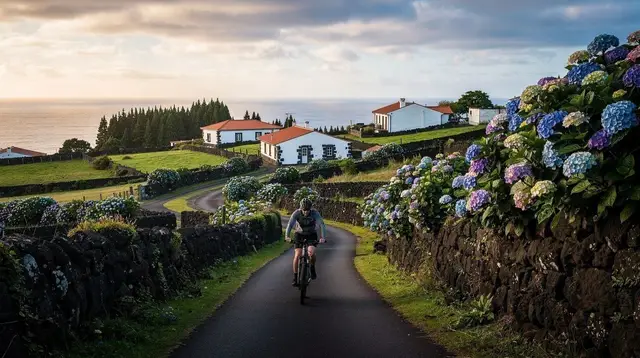
This is the practical starting point for anyone weighing an e-bike against a regular one, or against simply driving. São Miguel is not a mountain-biking destination with switchbacks and technical singletrack cut into a peak. It is closer to the opposite: a farmed, settled island of pasture and hedgerow, crossed by ordinary paved roads that happen to climb from the coast toward a volcanic interior almost everywhere you go. The gradients are rarely dramatic in isolation, but they are frequent, and they rarely let up for long. That combination — modest individual hills, stacked one after another, over a full day of riding — is exactly the kind of terrain where electric assistance changes how a ride feels without changing where you can go.
No Train, No Toll Road: How People Actually Get Around
Two things are worth stating plainly, because they shape every transport decision on the island, cycling included. There is no train on São Miguel, and there is no toll motorway either. The EN1-1A rings the island as its main coastal route, and a dual-carriageway via rápida connects Ponta Delgada with Ribeira Grande and Lagoa, but beyond that the road network is a patchwork of two-lane roads, some of them narrow, that were built for a farming population rather than for tourism at scale. Buses exist, run by a handful of regional operators, but they follow school and work schedules rather than sightseeing ones, and they thin out quickly once you leave the main towns.
The result is that a rental car remains the practical default for getting around São Miguel, and that fact does not change because a visitor decides to add an e-bike to the trip. What an e-bike changes is what happens once you are based somewhere for a day, or a few hours, and want a way to move through a place at a slower pace than driving allows, without the physical toll that the island’s terrain puts on a standard bicycle. It is an alternative form of local mobility, not a substitute for the car that gets you from Ponta Delgada to Furnas or out to Nordeste in the first place.
Where an E-Bike Actually Fits Into a Trip
Framed that way, the case for an e-bike on São Miguel is narrower and more useful than it might first sound. It is not a way to skip renting a car for a multi-day visit, and it is not a realistic way to cover the whole island end to end on a short trip. It is, instead, a good match for specific situations: a morning spent looping around one caldera rather than driving the full ring road, an afternoon exploring the streets and waterfront of a town on two wheels instead of on foot, or a slower alternative to a car for someone who wants to feel the island’s climbs and descents rather than watch them go by through a windscreen.
Ponta Delgada itself is a reasonable example. The city’s historic core is compact enough to walk, but its edges — the Portas do Mar waterfront, the residential hills behind the centre, the routes out toward Lagoa or the airport — spread out further than most people expect, and those approaches climb. An e-bike flattens that climb without removing the sense of covering real distance under your own power, which is part of what draws people to cycling in the first place. The same logic applies around Furnas, where the roads that link the village to its surrounding caldeiras, gardens, and viewpoints gain and lose height constantly over short distances.
What “Volcanic Relief” Feels Like on Two Wheels
It is worth being specific about what riders actually encounter, because “hilly” undersells it. Leaving almost any coastal settlement on São Miguel by bike means climbing, often within the first few hundred metres, as the road works its way up from sea level toward the farmland and forest of the interior.
The climbs are rarely long by the standards of a mountain pass — this is not a high alpine road, and none of it is equipped the way a serious cycling climb elsewhere in Europe would be, with switchback numbers or gradient signs. It is closer to a relentless rolling terrain: up out of one village, along a ridge with views back to the coast, down into the next valley, and up again. A ride that covers 20 or 30 km on the map can easily involve several hundred metres of accumulated climbing by the time it is finished.
Weather adds another layer. Conditions on São Miguel change quickly and unevenly — it is entirely possible to leave a village in sun and arrive somewhere else in the same afternoon under cloud or drizzle, and the passes near Lagoa do Fogo and Sete Cidades are the parts of the island most prone to fog and closure. None of that is specific to e-bikes, but it matters for planning one: a route that looks straightforward on a map can turn into a slower, wetter, and colder ride than expected, and the interior offers little shelter once you have committed to a climb.
Matching the Assistance to the Terrain
Electric assistance does not change the geography — a climb out of a caldera is still a climb — but it changes how much of a rider’s effort that climb consumes, and how much is left over for the rest of the day. On terrain like São Miguel’s, where climbs are frequent rather than singular, that difference tends to matter more than it would on a flatter island or a single, well-known mountain road. A rider on a standard bike who tackles one significant climb can recover on the flat sections that follow; a rider covering the same ground on São Miguel may find there is no flat section, only another climb starting as soon as the last one ends.
This is also why an e-bike suits São Miguel differently than it might suit a city with occasional hills. The assistance is not there to make an exceptional climb possible — nothing on the island’s road network requires that — it is there to keep a day of steady, repeated climbing manageable for a wider range of fitness levels, including a family group, a pair of visitors with different levels of cycling experience, or someone who wants to reach a viewpoint without arriving exhausted.
Riders who want a genuine physical challenge, or who are already comfortable on a loaded touring bike, are better served by the island’s routes on a standard machine; this page deliberately does not attempt to map those routes, which belong to a dedicated look at the island’s cycling routes and at cycling on São Miguel more generally.
Practical Realities: Weather, Roads, and Range
A few things shape any e-bike outing on the island regardless of who is running the rental. Roads are narrow in places, and on rural stretches cyclists share the carriageway with cars, tractors, and livestock being moved between fields — normal here, not a sign that a route has gone wrong. Fuel stations are sparse outside the main towns, and the same is broadly true of services aimed at cyclists once you are away from Ponta Delgada, Ribeira Grande, or the larger villages, so a day’s route benefits from being planned around where the day is likely to start and end rather than improvised.
Battery range is finite, and the island’s climbing profile uses more of it than flat terrain would for the same distance — a fact worth building into any plan rather than discovering partway around a caldera. Weather is the other variable that cannot be scheduled around reliably; the island’s own guidance is that conditions can differ from one side of a caldera to the other within the same hour, and a clear morning is not a promise of a clear afternoon. None of this rules out an e-bike outing, but it argues for shorter, well-bounded routes over ambitious full-day crossings, at least for anyone not already familiar with the island’s roads.
Guided Rides vs Riding Independently
Because judging terrain, weather, and road conditions on an unfamiliar island takes local knowledge, a number of visitors choose a guided e-bike ride over independent rental, at least for their first outing. A guided route removes the planning load: someone else has already decided where the climbs are manageable, where the views justify the effort, and when to turn back if the weather closes in. In the Furnas caldera, for instance, a guided e-gravel bike ride through the Furnas caldera covers the area’s steaming ground and garden landscapes with assistance built in from the start, rather than leaving a rider to discover the caldera’s climbs on their own.
Around the western caldera, a guided electric-assist ride around the Sete Cidades caldera rim takes in the views over the twin lakes without requiring a rider to have scouted the approach roads beforehand — useful given how often that pass sits in cloud.
For visitors who want to cover more ground and are comfortable on a bike for a full day, a supported gravel ride crossing the island coast to coast is a longer alternative that takes in more of the interior’s climbing in one outing. Independent rental, by contrast, gives more control over pace, stops, and photo breaks, but it puts the same weather and terrain judgment calls on the rider that a guide would otherwise handle.
Who an E-Bike Actually Suits
Put together, an e-bike suits a fairly specific visitor to São Miguel: someone who wants to explore a town, a caldera, or a stretch of coast at a slower, more physical pace than driving allows, without the toll that the island’s constant climbing would take on a standard bicycle. It suits families with a mix of ages and fitness levels, visitors recovering from injury or simply out of cycling practice, and anyone who wants the freedom to stop often without worrying about finding parking. It does not suit anyone hoping to replace a rental car for a multi-day trip, or anyone expecting flat, easy riding between the island’s main areas — that expectation belongs on a different island.
Planning Around the Rest of the Trip
An e-bike day works best when it is planned as one part of a wider itinerary rather than the spine of the whole trip. Most visitors still need a car to move between the island’s separate areas — Ponta Delgada, Sete Cidades, the north coast, Furnas, Nordeste, and the south coast are far enough apart that cycling between them is a serious undertaking, not a casual add-on.
Deciding how many days the trip needs, and comparing guided tours against self-driving for the rest of the itinerary, gives an e-bike outing a clear place to sit rather than competing with the logistics of the trip as a whole. For visitors still deciding how to reach the island in the first place, the practicalities of getting to São Miguel and what to pack are worth settling before the cycling details.
None of this makes São Miguel unusual among volcanic islands — it simply means that the fastest way to plan an e-bike outing is to accept the terrain for what it is: a steady, farmed landscape stitched together by climbs, without a train and without a toll road to shortcut them. An e-bike does not remove those climbs. It changes how much they cost a rider to complete, which on this particular island is the whole point.
Cycling on GetYourGuide
Verified deep-linked GetYourGuide tours. Book through these links and we earn a small commission at no cost to you.
GetYourGuide does not provide a product photo for this activity — the image shows the meeting point, photographed by us.