No Snakes in the Azores? Watch the Sea Instead
I packed for São Miguel the way I pack for anywhere warm and green: closed shoes for the trails, a torch for turning over the odd rock, and a half-formed plan to watch where I put my hands on any wall covered in ferns. Three days in, I realised how much of that plan was aimed at an animal that does not exist here. There are no snakes on São Miguel. There is no venomous spider worth naming, no scorpion, nothing in the hedgerows that wants to bite you. The island’s only wildlife-related danger sits in the ocean and in the air, not in the grass, and I had been pointing my caution in entirely the wrong direction.
It is an easy mistake to make, because most of us learned our travel instincts somewhere tropical, where a rustle in the undergrowth is exactly the thing to worry about. The Azores were never colonised by land reptiles or mammals large enough to threaten a person — they are volcanic islands that rose out of open ocean, over a thousand kilometres from any coastline, and most of what lives here either flew in, floated in, or arrived with the Portuguese settlers in the fifteenth century as cattle, rats and garden plants.
Walk the hiking trails around Lagoa do Fogo or up through the laurel forest of the Serra da Tronqueira and the worst thing that can bite you is a horsefly in August. If anything, the animal story here is the opposite of frightening: the forest around the Tronqueira is one of the last strongholds of the priolo, the Azores bullfinch, a bird so rare and so shy that most visitors never see it at all.
So I stopped watching the path for the wrong reasons, and started paying attention to what was actually putting me at risk — which, it turns out, is everything about the island being young, volcanic, wet and stuck in the middle of the North Atlantic.
Where the real risk lives
The sea is the obvious one, and the one I underestimated most. São Miguel’s coast is black lava rock, not sand for the most part, and the swell that built those cliffs does not stop being dangerous just because a spot looks calm from above. At Ponta da Ferraria, where a hot spring bubbles up through the sea at the foot of a lava flow, the pools are genuinely only safe to enter around low tide — at high tide or with any swell running, the same water that feels like a warm bath becomes a place where the ocean can put you against volcanic rock without warning.
I checked the tide times before going and was glad I had; a couple arrived an hour after us at high water and simply stood on the rocks taking photos, which is the right call. The surf beach at Praia de Santa Bárbara on the north coast is a proper Atlantic beach with rip currents that locals respect and visitors sometimes don’t, and the water stays cool enough year-round that cold shock is a real factor too, not just strength.
Cliff edges are the second thing I had to recalibrate for. São Miguel’s viewpoints are largely unfenced, because they are farmland and pasture as much as they are scenery — this is a working, farmed island, not a managed park with safety rails everywhere you might want a photo. The crater rims above Sete Cidades, the coastal paths near Nordeste, the ridge above Pico da Vara — all of it rewards a good head for edges and punishes a bad one. Wind is part of that risk too: a gust that would just be annoying on a city street can matter a great deal on a narrow section of cliff path.
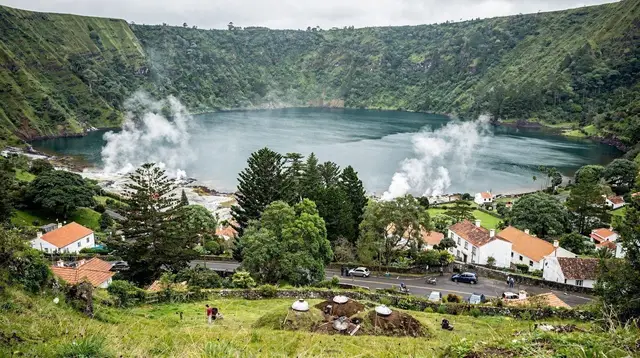
Then there’s the fog, which caught me properly off guard the first time it happened. We drove up towards Lagoa do Fogo on a morning that had started clear in Ponta Delgada, and within twenty minutes of climbing we were inside a cloud thick enough that I slowed to walking pace with the hazards on. This isn’t unusual weather for the crater — it’s normal weather, and the viewpoint over the lake clears and closes over again on its own schedule, sometimes within the same hour. Combine that fog with unfenced ground and you have the island’s real hazard pairing, and it has nothing to do with anything that crawls.
And then, less dramatically but more often, there’s the sun. São Miguel’s weather changes by the hour and by the district — it can be raining in Furnas while Ponta Delgada is dry twenty minutes away — and that pattern of shower, then sudden brightness, then shower again is exactly the kind that catches people out. You don’t feel like you’re being sunburnt between two rain showers, and by the time you notice, you are.
What actually changed how I packed
None of this means I regret bringing sturdy shoes — the volcanic terrain deserves them regardless of what does or doesn’t live in it. But my second trip’s packing list looked different: a windproof layer for the ridge walks, reef shoes for anything near Ponta da Ferraria, a tide table saved on my phone, and sunscreen I reapplied on cloudy days as much as clear ones. I also stopped assuming a boat trip or a coastal walk would go ahead as booked; operators here cancel for sea state far more readily than you’d expect from a European destination, and that’s a sign of sensible caution, not disorganisation.
If you want a guided sense of the terrain before you’re on it alone, going out with people who read this weather and this coastline for a living takes a lot of the guesswork away — the Hidden Gems of São Miguel Azores Tour covers a good cross-section of viewpoints and coastal stops with a driver who knows which roads close in fog, and the full-day 4x4 tour out to Nordeste puts you on the wilder eastern cliffs with someone else doing the navigating.
For the interior caldera country, the 4WD tour through Furnas is a good way to see the fumarole ground without wondering where the safe footing actually is.
None of this is meant to make São Miguel sound dangerous — most days here are simply green, mild and slow. It’s meant to point your attention where it belongs. The island genuinely has no snakes and nothing venomous worth worrying about; it does have an ocean, a volcano and an Atlantic sky that all deserve to be taken seriously, in that order.
São Miguel’s real hazards, answered
Are there snakes in the Azores?
No. There are no snake species, native or introduced, anywhere in the Azores archipelago, including São Miguel. You can walk any trail on the island without that particular worry.
Is São Miguel safe for hiking?
Yes, in the sense that there’s no dangerous wildlife to plan around. The real considerations are unfenced cliff edges, fast-changing fog on higher ground like Lagoa do Fogo, and sudden rain — dress and pace for the weather, not for animals.
Is it safe to swim at Ponta da Ferraria?
Only around low tide, when the sea pools at the base of the lava flow are calm enough to enter. At high tide or in any swell, the same spot becomes genuinely dangerous, so check tide times before you go.
Why does it get foggy so quickly at Lagoa do Fogo?
The crater sits high enough on the Água de Pau massif to catch Atlantic cloud, which can roll in and clear again within the same hour. It’s normal weather for the site, not a rare event, and the access road can close when visibility drops too far.
Is the sun dangerous even on a cloudy or rainy day?
Yes. São Miguel’s weather often alternates sunshine and showers within the same afternoon, and it’s easy to get sunburnt during the bright spells without noticing, especially near water or at altitude.
Are there any biting insects or plants to worry about?
Nothing serious. Horseflies show up in warmer months and hydrangea hedges can scratch, but there’s nothing venomous or medically dangerous in the island’s plant or insect life.
What’s the biggest real risk for visitors on São Miguel?
Rip currents and rough seas along the black-rock coastline, closely followed by unfenced viewpoints in wind or fog. Both are manageable with basic caution — tide awareness, sturdy footing, and not pushing past a barrier for a photo.
Tea & Pineapple Plantations on GetYourGuide
Verified deep-linked GetYourGuide tours. Book through these links and we earn a small commission at no cost to you.
GetYourGuide does not provide a product photo for this activity — the image shows the meeting point, photographed by us.