The Hot Spring You Can Only Catch at Low Tide
Why I Nearly Missed the Water Entirely
I had read about Ponta da Ferraria before I ever drove out to São Miguel’s west coast, and I had built the wrong picture in my head. I imagined something like a public thermal pool: a fixed pool of hot water, open from morning to evening, that you could turn up to whenever the day allowed. What I found instead, on my first attempt, was a churning stretch of ocean over black rock, with a rope strung between two points and nobody in the water at all. I had arrived two hours after low tide, and the window had already closed.
That mistake is the reason I am writing this rather than a straightforward “how to visit” piece. Ponta da Ferraria is not a swimming pool with a schedule you can ignore. It is a hot spring that happens to sit inside the sea, and the sea decides when you can use it.
Where the Heat Actually Comes From
The spring is at the very tip of the island’s western point, where a black lava flow runs down into the Atlantic. Geothermal water rises through the rock here and mixes directly with the ocean at the shoreline, which is what makes it different from every other hot spring on São Miguel. At Terra Nostra or Poça da Dona Beija the water is channelled into a built basin, away from any tide. At Ponta da Ferraria it is not channelled anywhere. You are stepping into a set of natural rock pools that the ocean fills and empties twice a day, and the hot water only stays contained, and only stays safe, while the tide is low.
Understanding that one fact changes how you plan the visit. It is not a stop you slot in on the way past. It is a stop you build the rest of the day around.
Reading the Tide, Not the Clock
Before I go back, I check a tide table for the day, because the safe window moves. It is roughly the two hours either side of low tide, and outside that window the sea comes in over the lava shelf hard enough to make the pools unusable and genuinely dangerous, not just less pleasant. High tide or any real swell rules it out completely; this is open Atlantic, not a sheltered cove. I now treat the tide time as the anchor for the whole outing, the way I would treat an opening hour anywhere else, except here missing it by an hour does not mean a shorter visit, it means no visit.
If you are coming from Ponta Delgada or basing yourself near Sete Cidades, I would rather arrive early and wait nearby than arrive late and find the window already gone. The drive out along the west coast, past Ginetes toward the point, is short enough that timing it around the tide costs very little.
The Spa Upstairs Is a Different Day Out
On my second visit I also worked out something that had confused me from the descriptions online: the paid spa sitting above the sea pools is not the same experience, and not a fallback for a missed tide. It has its own changing rooms, its own basins, and its own opening hours, fed from the same geothermal source but built and maintained as a normal facility. You can visit it at almost any time of day, tide aside, and it is the more comfortable, more predictable option if the sea window does not line up with your schedule.
What it is not is a substitute for the free bathing in the rocks below. The two get lumped together in a lot of trip planning, and I think that is where most of the disappointment comes from — people arrive expecting one thing and are quietly handed the other, or find the gate to the sea pools closed and assume the whole place is shut. They are two separate visits, at two separate price points, on two separate schedules, in the same small stretch of coast.
Mosteiros and Ginetes, the Rest of This Coast
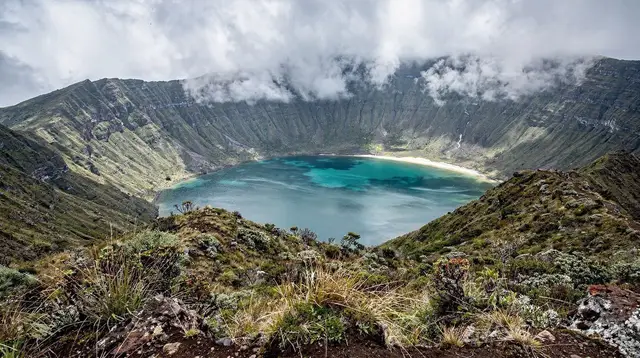
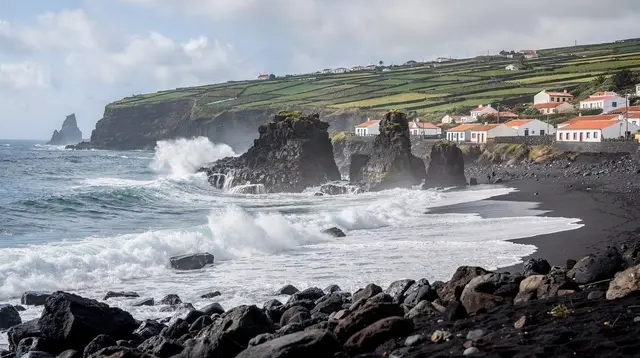
Ponta da Ferraria is not an isolated curiosity sitting alone at the end of a road. It is one point on an active volcanic coastline that also holds Mosteiros, with its black-sand beach and sea stacks, and the quiet farming village of Ginetes above it. I treat the three as one loop rather than three separate errands: the lava point and its tidal spring, the beach with the stacks a short drive north, and the green hillside road connecting them back toward Sete Cidades and its caldera lakes.
Seeing it that way also puts the spring in its right context. This is not a spa built for tourism; it is one visible seam of an island that is still geologically active, on a coastline shaped entirely by lava reaching the sea. The tide rule is not a booking inconvenience invented for visitors. It is the ocean doing what the ocean does to a lava shelf, twice a day, whether anyone is planning around it or not.
How I Would Plan the Visit Now
I no longer treat Ponta da Ferraria as a stop I can reach “sometime in the afternoon.” I check the day’s low tide first, then work the rest of the west coast loop around it — Mosteiros, Ginetes, and the run back past Sete Cidades — so the spring sits at the centre of the plan rather than the edge of it. If the tide and the schedule genuinely will not line up, I go for the paid spa instead and save the sea pools for a day when they will.
For a guided version of this coast, a half-day jeep tour that swings through the Sete Cidades caldera and the western coastline is the easiest way to see the area without driving the narrow roads yourself, though I would still ask ahead whether a tide-dependent stop is on the route that day.
If you would rather set your own pace, a buggy tour out of Ponta Delgada lets you build the loop around the tide table directly. And if you are only ashore for a few hours from a cruise call, the west coast is a stretch worth confirming is included on a shore excursion from Ponta Delgada before you commit a tight window to it.
Either way, the rule stays the same: check the tide before you check anything else. For the tables and the exact timing I use, see the Ponta da Ferraria tide times guide and the comparison of the spa against the sea pools. For pairing the stop with the rest of this coast, the Mosteiros and Ponta da Ferraria day trip and the Sete Cidades half-day route from Ponta Delgada are the two I keep coming back to.
And if you want to see how this spring sits against São Miguel’s other thermal spots, the comparison of the island’s thermal pools is the honest way to weigh them against each other, alongside a wider look at why São Miguel is not the whole Azores and why the weather here changes hour to hour rather than settling into a single forecast for the day.
Ponta da Ferraria Hot Spring: Your Questions Answered
Is Ponta da Ferraria open all day like a swimming pool?
No. The free sea-level bathing only works around low tide, for a window of roughly two hours either side of it. Outside that window the pools are covered by the sea or too rough to enter safely.
What is the difference between the spa and the natural hot spring?
The spa is a paid, built facility on the cliff above, with changing rooms and fixed hours, fed by the same geothermal water. The natural hot spring is free, at sea level, inside the tidal rocks, and only usable around low tide.
How do I find the low tide time before I go?
Check a Ponta Delgada or São Miguel tide table for the day, since tide times shift daily and the west coast follows the same schedule. I plan to arrive about ninety minutes before low tide so I am in the water as the pools fully open up.
Is it dangerous to swim there at high tide?
Yes. At high tide or with any swell running, the sea washes straight over the lava rocks that form the pools, and the current at the point is strong. High tide there is treated as a no-swim time, not a rougher version of the same swim.
Can I visit Ponta da Ferraria as part of a day trip from Ponta Delgada?
Yes, it sits on the west coast near Mosteiros and Ginetes, within reach of a half-day loop around Sete Cidades and the western coastline. I would still build the stop around the tide table rather than the rest of the itinerary.
Is the water actually hot, or just warm sea water?
It is genuinely hot where the spring meets the sea, close to body temperature and warmer in patches, and it cools the further you swim from the outflow. It is not simply sun-warmed ocean.
tours.Practical
Verified deep-linked GetYourGuide tours. Book through these links and we earn a small commission at no cost to you.
GetYourGuide does not provide a product photo for this activity — the image shows the meeting point, photographed by us.