Ponta da Ferraria: Paid Spa or Free Sea Pool?
What's the difference between the Ponta da Ferraria spa and the natural hot spring?
The natural spring is free and sits inside the sea itself, at the foot of a lava flow, and it is only safe to enter around low tide. The paid spa sits on the cliff above it, in an enclosed pool fed by the same volcanic heat, and works on its own schedule regardless of the tide. They are two different places with two different risk profiles, not one experience with two entrances.
Two hot pools, one headland, easy to mix up
At the far western tip of São Miguel, where the island’s youngest lava flow runs into the Atlantic, there are two ways to sit in naturally heated water at Ponta da Ferraria — and they are not the same thing wearing two prices. One is a spring that surfaces inside the sea itself, free to enter, with no gate and no staff, governed entirely by the tide. The other is a small built spa on the cliff above it, with an entrance fee, a changing room, and hours that have nothing to do with the ocean below.
Visitors who plan for one and arrive expecting the other are usually disappointed in one direction or unsettled in the other: disappointed if they pay for the spa expecting the wild, cliff-and-spray version of a hot spring, or unsettled if they turn up at the sea pool at the wrong tide and find the calm, warm bathing they’d read about replaced by surf breaking over volcanic rock.
This page is about telling the two apart before you go — what each one physically is, what it costs, what it includes, and the one mistake that actually matters: treating the paid spa as a safer version of the sea pool, or as some kind of backup plan for a high tide. It doesn’t cover how to time a swim in the sea pool itself, or the tide tables that govern it — that’s covered on its own page, linked below. Here, the job is simpler: know which one you’re heading for.
Where each one actually sits
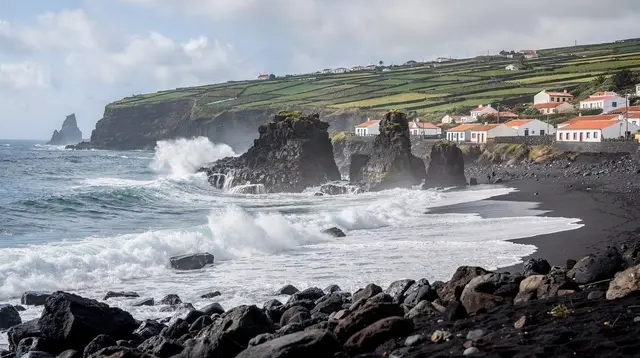
Ponta da Ferraria is the westernmost point of São Miguel, a low, black headland of relatively recent lava beyond Mosteiros, reached by the same road that loops past Sete Cidades on a circuit of the island’s volcanic west. The lava here runs straight into open Atlantic water, and somewhere in its cooling the rock trapped a source of volcanic heat that still warms the sea at the point where the flow meets the waves.
That warm water rising into the sea is the natural spring — an open, unenclosed spot in the ocean itself, at the foot of the lava. It has no infrastructure: no reception desk, no ticket booth, no lifeguard, no fixed hours. What it has instead is a relationship with the tide that decides, hour by hour, whether the spot is a warm, sheltered pool or a stretch of rock being hit by open Atlantic swell. That relationship — and how to read it before getting in — is the subject of a separate page on this site, not this one.
A short walk up from the shoreline, on the cliff above, sits the paid spa: a small, purpose-built facility with its own enclosed pool, fed by the same underlying volcanic heat but captured, channelled and held apart from the sea. It has a car park, a ticket window, changing rooms of a kind, and a schedule that has nothing to do with the tide chart. It is, in every practical sense, a different destination that happens to share a name and a headland with the sea pool below it.
What the paid spa actually offers
The spa at Ponta da Ferraria is modest by the standards of somewhere like Terra Nostra Park or Poça da Dona Beija further east — there’s no landscaped garden, no orange iron-rich water, no century of planting around it. What it does offer is a warm, enclosed pool that doesn’t care whether the tide is in or out, doesn’t carry Atlantic swell, and doesn’t require reading a chart before you commit to getting wet.
| Paid spa (cliff-top) | Free sea pool (shoreline) | |
|---|---|---|
| Access | Entrance fee, staffed | Free, unstaffed, no gate |
| Water | Captured, channelled pool | Open sea at the spring’s mouth |
| Depends on tide | No — fixed schedule | Yes — usable only near low tide |
| Safety in swell | Unaffected | Can become dangerous |
| Facilities | Changing area, basic amenities | None |
| Character | Small, functional, predictable | Wild, weather-dependent, dramatic |
| Best for | Kids, unpredictable swell days, no tide planning | Calm seas, correct tide, adaptable visitors |
Because it isn’t tied to the tide, the spa is the more bookable, more plannable half of a visit to Ponta da Ferraria — the part you can put a time against. It’s a reasonable stop to fold into a longer loop of the west coast, alongside Sete Cidades or the Mosteiros and Ponta da Ferraria day trip, precisely because it doesn’t force the rest of the day’s timing around a single low-tide window.
What the free sea pool is, in outline
The sea pool is the reason Ponta da Ferraria has a reputation beyond the west of the island: a genuinely wild spot where hot volcanic water meets cold Atlantic water at the exact point the lava enters the sea, with no barrier between the warm and the wild. It’s the more talked-about of the two, and for good reason — there’s nothing quite like it elsewhere on São Miguel.
But it is, structurally, just the open sea at a point where it happens to be warm. That means its usability swings entirely on conditions outside anyone’s control: it is only sensibly enterable around low tide, when the water is shallow and calm enough to sit in without being knocked against volcanic rock, and it becomes genuinely dangerous at high tide or in any swell, when the same water that was a warm bath an hour earlier is breaking waves over the same spot.
Reading the tide correctly, and knowing what a safe window actually looks like on the ground, is enough material for its own guide — see the tide times guide and the hot spring swimming guide for that. What matters here is just the shape of the fact: this pool is not a facility, it’s a window, and the window opens and closes with the ocean.
The mistake worth avoiding
The one thing to get right, more than any price or opening hour, is not to let the two blur into each other. The paid spa is not a safer or more controlled version of the sea pool that you can fall back on when the tide is wrong. Paying the entrance fee at the spa doesn’t grant access to the shoreline spring, doesn’t change what the sea is doing at the foot of the lava flow, and doesn’t make a high-tide swim in the open water any safer than it would otherwise be. They are simply two unconnected places that happen to sit on the same short stretch of coast.
In practice this matters most for visitors who build a day around “doing Ponta da Ferraria” without deciding in advance which of the two they actually want. Arrive at high tide hoping to swim in the famous sea pool, find it unusable, and the paid spa above is a perfectly fine consolation — a warm pool is still a warm pool — but it is a different visit, not a substitute for the one that was planned. Go in with that expectation and neither option disappoints; go in assuming they’re interchangeable and one of them probably will.
It cuts the other way too: the spa is not a preview or a “safe practice” version of the sea pool either. A calm, enclosed pool on the cliff tells you nothing about what the open water below is doing that day, and shouldn’t be read as reassurance about conditions at the shoreline.
Practical basics for the spa visit
- Entrance fee: a modest sum, well under the cost of Terra Nostra’s gardens or the eastern thermal circuit — this is a functional facility, not a resort.
- What’s included: access to the pool itself and basic changing space; don’t expect towels, robes or a café on the scale of the bigger thermal parks.
- Capacity: it’s small. In peak summer weeks — see the best thermal pools compared for how it stacks up against the island’s other options — a midday arrival in late July or August can mean queuing or a temporarily full pool; outside those weeks it’s rarely an issue.
- Getting there: the spa sits on the same access road as the headland, past Mosteiros on the loop that also passes Sete Cidades — a rental car is the practical way to reach it, as it is for most of the island’s west coast.
- What to bring: swimwear that’s already seen better days is sensible here too, given the mineral content of Azorean thermal water generally — the same caution that applies at Terra Nostra is a reasonable habit to keep across every hot pool on the island.
Choosing between them, or doing both
For a visitor with a flexible schedule and a correct low-tide window, the sea pool is the experience that makes Ponta da Ferraria worth the drive in the first place — nothing else on São Miguel replicates hot spring water inside open ocean swell. For a visitor who can’t or doesn’t want to plan around the tide — travelling with small children, visiting on a day with any swell forecast, or simply passing through on a fixed itinerary — the paid spa above is the dependable version of the same underlying idea: volcanic heat, captured and made safe to sit in on demand.
Doing both in the same stop is entirely possible, since they’re a short walk apart on the same headland, and there’s no rule against a warm, enclosed soak at the spa followed by a look at the sea pool below to judge the tide for another day. What doesn’t work is treating a ticket to one as access to the other.
Most visitors reach Ponta da Ferraria as part of a longer loop of the island’s volcanic west rather than as a single-purpose trip, pairing it with the crater lakes at Sete Cidades or the black-sand coast at Mosteiros. A guided option covering that side of the island removes the tide-planning question from the itinerary entirely — worth weighing if the schedule doesn’t allow for chasing a low-tide window.
The half-day Sete Cidades tour and the full-day Sete Cidades and Lagoa do Fogo tour both run through this side of the island, and travellers who’d rather cover the ground on two wheels than four can look at the e-bike tour around Sete Cidades instead.
For thermal bathing more broadly, Ponta da Ferraria’s pair of options is only one entry in a wider set across the island — see how it compares with the eastern circuit around Furnas, and if a whole day built around hot water sounds appealing, the wellness day planning guide lays out how to combine more than one stop without wasting a day on the road. The hot springs and thermal category and the Ponta da Ferraria activity page round out the options at this specific headland.
Ponta da Ferraria: spa vs. sea pool
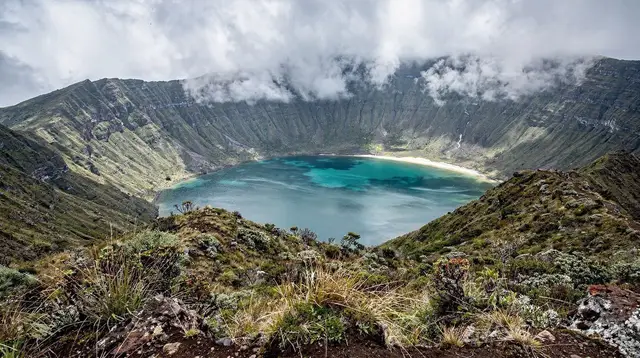
A day covering São Miguel’s volcanic lake scenery is a natural companion to a stop here, since the drive out to Ponta da Ferraria already passes close to the same crater landscapes. Whichever pool ends up being the one you get into, arrive knowing they’re separate stops with separate logic — one running on a ticket and a clock, the other running on the ocean.
Is the paid spa at Ponta da Ferraria the same water as the sea pool?
They share the same underlying volcanic heat source, but they are physically separate pools — the spa’s water is captured into a built enclosure on the cliff, while the sea pool is open water at the shoreline that mixes freely with the Atlantic.
Can I use the paid spa instead of swimming in the sea pool at high tide?
No. The spa isn’t a safer stand-in for the sea pool and doesn’t make the shoreline swimmable when the tide or swell makes it dangerous. They’re separate visits with separate access; one does not substitute for the other.
Do I need to book the spa in advance?
It’s a small facility, so a busy midday in July or August can mean a wait. Outside peak summer weeks, turning up without a booking is usually fine, though checking current hours before driving out is worth doing.
Is the free sea pool always open?
It has no gate, ticket or fixed hours because it’s simply the sea meeting a warm spring — access depends entirely on tide and swell. Tide timing itself is covered on a separate page.
Which one is better for young children?
The spa’s enclosed, tide-independent pool is the more predictable choice with kids, removing the swell, slippery rock and changing water levels that come with the open sea pool.
Is the spa expensive?
It’s a modest entrance fee, well below Terra Nostra or Poça da Dona Beija, covering access to the pool and basic changing facilities — a small, functional spa rather than a resort.
Can I visit both the spa and the sea pool in one stop?
Yes, physically — they’re a short walk apart on the same headland. Whether the sea pool is actually enterable that day depends on the tide, so treat the spa as the reliable half of the visit and the sea pool as the conditional half.
Comparison on GetYourGuide
Verified deep-linked GetYourGuide tours. Book through these links and we earn a small commission at no cost to you.
GetYourGuide does not provide a product photo for this activity — the image shows the meeting point, photographed by us.