Portas do Mar: Ponta Delgada's Marina and Sailing Waterfront
What is Portas do Mar in Ponta Delgada?
Portas do Mar is the reclaimed waterfront on the edge of Ponta Delgada, São Miguel's capital of roughly 68,000 people, combining the town's cruise ship berth, its marina for private and visiting yachts, and a public promenade a short walk from the old town. It sits about 2-3 km from João Paulo II airport (PDL), which makes it the practical starting point for anyone arriving by sea or leaving by boat.
The waterfront that put Ponta Delgada back to sea
For most of its history, Ponta Delgada turned its working face toward the water and its polite face toward the streets behind it. Portas do Mar changed that. Built as a reclaimed strip along the harbour edge of the island capital, it gathers three things that used to sit apart — a cruise ship berth, a marina for private and visiting yachts, and a public promenade — into one continuous stretch of waterfront a short walk from the old town.
It is the reason a cruise passenger can step off a ship and be at the Portas da Cidade arches in ten minutes, and the reason a sailor crossing the Atlantic aims for this particular stretch of coast rather than any of the smaller harbours further along the island.
Ponta Delgada is the largest town in the Azores and the seat of a municipality of roughly 68,000 people, and Portas do Mar is scaled to match — it is not a fishing cove with a few private moorings tacked on, but the main maritime gateway for an island of about 137,000 residents. João Paulo II airport (PDL) sits only 2-3 km from the centre, which means the town’s two main points of arrival, one by air and one by sea, are almost within sight of each other. Anyone who lands at PDL and later walks down to look at the boats is covering a distance most cities would call a single neighbourhood.
This page is about what Portas do Mar actually is and how it works as a marina and sailing waterfront — not about the general roster of tourist boat trips that also happen to leave from the same quay, which has its own guide.
What Portas do Mar actually is
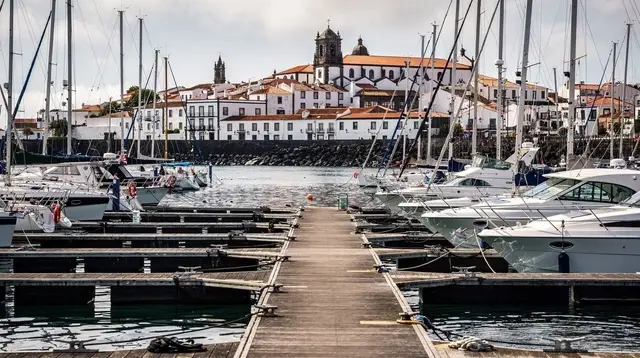
Before the development, Ponta Delgada’s harbour front was a working dock — functional, but not somewhere visitors lingered. Portas do Mar rebuilt that edge as a single piece of infrastructure with several jobs at once. The cruise berth lets large ships tie up directly against the town rather than anchoring offshore, so passengers walk ashore instead of tendering in. The marina, a separate but adjoining basin, holds private sailboats and motor yachts, both those based in the Azores and those passing through. And the public promenade running along the top ties the whole thing together with restaurants, benches, event space and a dedicated bathing area, open to anyone on foot.
That layout matters for how the place feels. A marina on its own is usually a quiet, slightly private world of gangways and locked gates. Portas do Mar is that, but wrapped in a public seafront that keeps people moving along it all day — locals on an evening walk, cruise passengers with a few hours ashore, and visitors heading down after dinner to look at the boats. The result is one of the few points in Ponta Delgada where the working harbour and the town’s social life overlap directly, rather than the port being fenced off behind a road.
The marina: who ties up here, and why
The marina at Portas do Mar is the largest and most serviced yacht harbour in the Azores, which is really a function of geography as much as design. São Miguel sits roughly midway across the North Atlantic, on or near several of the classic sailing routes that link the Caribbean, the eastern seaboard of North America and mainland Europe.
Boats making an Atlantic crossing in either direction have long used the Azores as a landfall — a place to break the passage, take on water and fuel, make repairs, and wait for a weather window before the next leg. Among the nine islands, Ponta Delgada offers the most complete set of services for that kind of stop, so a meaningful share of the yachts that pass through the archipelago each year end up tied up here rather than at one of the smaller island harbours.
Alongside the transatlantic traffic, the marina also serves boats based locally or elsewhere in the Azores, private yachts owned or chartered on the island, and the growing number of skippered sailing outings that use Portas do Mar as their home dock. It is, in other words, a working harbour with several overlapping populations of boats rather than a single type of user — long-distance cruisers, day-sailing charters, and locally based craft all share the same basin.
What this guide will not do is put a number on how many berths the marina holds or what it costs to tie one up for a night. Those figures change, vary by boat length and season, and are not something worth guessing at — anyone actually planning to berth a boat here needs to go directly to the marina authority for current availability and rates, not rely on a travel guide’s estimate.
Sailing from Portas do Mar as a visitor
You do not need to own a boat to experience Portas do Mar under sail. A handful of operators run skippered sailing trips directly from the marina, distinct from the motorised excursions that share the same waterfront — the difference is a boat moving under canvas, with the quieter pace and different vantage that comes with it, rather than an engine-powered tour boat.
The shortest and most popular version is an evening sail, timed to be on the water as the light drops over the harbour and the coastline west of town. For a couple of hours out from Portas do Mar under sail as evening falls, with the option of a smaller, more private version of the same idea, see the evening sailing tour from Ponta Delgada or, for a private group, the private sunset sailing trip out of the marina.
For visitors with more of the day free, a longer outing under sail gets further along the coast and gives more time on the water rather than just the last hour of light. The half-day sailing trip from Ponta Delgada covers more distance and typically pairs the sail with time to swim or simply sit on deck away from the harbour traffic.
Not every departure from Portas do Mar is a coastal sail. Some outings combine a boat leg with time ashore at a specific spot along the north coast — the Fenais da Luz nature and community experience is built around exactly that kind of mixed day, starting from the same waterfront but built around a village and its coastline rather than the sailing itself.
None of these trips are the general whale-watching or coastal sightseeing boats that also use Portas do Mar in large numbers — those run on motor rather than sail and are covered separately in the Portas do Mar boat tours guide. What sets the sailing trips apart is the boat itself: canvas rather than an engine as the main means of getting from A to B, at least for part of the route.
Portas do Mar and the cruise ship trade
The other half of the waterfront’s job is handling cruise calls, and it is worth understanding how directly this connects to the marina next door. Ponta Delgada is the main Azorean port of call for transatlantic and repositioning cruise itineraries, and because Portas do Mar puts the berth right against the edge of town, a ship’s arrival changes the character of the whole waterfront for the day — more people on the promenade, more activity around the marina basin, restaurants busier than usual.
Passengers on a call typically have a matter of hours ashore, and Portas do Mar’s location means that time is not eaten up by transfers: the old town, the Mercado da Graça food market and the Portas da Cidade arches are all within a short, flat walk of the berth.
For anyone planning a stopover built around a cruise call, this proximity is the whole appeal of Ponta Delgada as a port — it is one of the few Atlantic stops where a passenger with limited hours can genuinely reach the town centre on foot rather than needing an organised excursion just to get off the dock. If that is your situation, the cruise ship stopover itinerary is built specifically around that time constraint.
No ferry, and what that means for the marina’s role
It is worth being clear about one thing Portas do Mar is not: a ferry terminal to the mainland. There is no ferry service connecting São Miguel to mainland Portugal — the only way to and from the continent is by air, a point covered in full in the guide to reaching São Miguel and in the wider explanation of why there is no mainland ferry.
Inter-island travel within the Azores is a different matter, served by smaller ferries and flights rather than anything departing from the marina at Portas do Mar, and the practicalities of moving a boat between islands are covered separately in the guide to sailing and inter-island crossings in the Azores.
What this means for Portas do Mar is that its marina function is almost entirely about ocean-going and coastal sailing — transatlantic yachts, chartered sailing trips, and locally based boats — rather than about scheduled passenger transport. The harbour moves people around the coastline and across the ocean, not between the mainland and the islands.
The public side: walking the waterfront and swimming
Even without setting foot on a boat, Portas do Mar is worth the walk on its own terms. The promenade runs the length of the development, past the marina’s pontoons on one side and open water on the other, with restaurants and cafés set back from the water and benches along the rail for watching boats come and go. In the evening, this is where a good part of Ponta Delgada goes to walk off dinner, and it is where the sailing trips above set off from as the light drops — worth timing a visit to coincide with a departure if the boats themselves are the draw.
The development also includes a dedicated bathing area built into the waterfront, separate from the marina basin itself, used by locals for a swim in town during the warmer months without needing to leave the centre for one of the island’s beaches. It sits alongside rather than inside the working harbour, so swimmers and moored yachts are not sharing the same water.
For a wider view of what else the harbour offers beyond the marina and sailing trips — the general boat excursions, whale-watching departures and other craft that also use this stretch of coast — the dedicated guide to Portas do Mar boat tours covers that ground. And for the town around it, the Ponta Delgada city day trip guide and the old town walking guide pick up where the waterfront ends.
Getting there and planning around it
Portas do Mar sits at the edge of central Ponta Delgada, close enough to the airport that arriving visitors can reach it within minutes of landing, and close enough to the old town that no transport is needed to combine the two on the same day. Visitors renting a car on São Miguel will find parking in the surrounding streets rather than at the waterfront itself, and the whole area is easily covered on foot once you are there.
Sailing departures, like any boat activity on São Miguel, are weather-dependent, and Atlantic conditions can change a schedule at short notice even on a day that looks calm in town — a point covered more generally in the guide to weather and boat trip cancellations. Booking a sailing trip in advance, particularly in the busier summer months, is the safer approach, and building in a spare day or two if a specific sail matters to your trip is worth doing rather than relying on one fixed slot.
Portas do Mar and the sailing waterfront: frequently asked questions
Is Portas do Mar a marina, a port, or a promenade?
All three at once. Portas do Mar is a single reclaimed waterfront development that holds Ponta Delgada’s cruise ship berth, a marina for private and visiting sailboats and motor yachts, fishing and harbour infrastructure, and a public esplanade with restaurants, a swimming area and event space. It replaced an older, more industrial harbour front and now functions as the town’s main water-facing public space as well as its working port.
Can I just walk into the marina and look at the boats?
Yes. The promenade along Portas do Mar is open and public, and it runs directly past the marina basin, so you can walk the waterfront, watch boats coming and going, and see the cruise berth without any ticket or booking. Access to the pontoons themselves, where the yachts are actually tied up, is restricted to boat owners, crew and marina staff, as at any working marina.
Do cruise ships dock right in the town centre?
Yes, that is the point of Portas do Mar. The cruise berth sits inside the same waterfront development as the marina, within walking distance of the Portas da Cidade arches and the old town’s main streets, so passengers on a call day can go ashore on foot rather than needing a shuttle bus into the centre.
Is Ponta Delgada a stop for boats crossing the Atlantic?
São Miguel sits on classic transatlantic sailing routes between the Caribbean or the Azores’ own outer islands and mainland Europe, and Ponta Delgada’s marina at Portas do Mar is the natural landfall for boats making that passage, since it is the largest, most serviced harbour in the archipelago. Exact berthing availability and formalities are handled directly with the marina and are not something a visitor can book from outside.
Can I go sailing from Portas do Mar without owning a boat?
Yes. A number of skippered sailing trips, from short evening outings to half-day sails, depart from the Portas do Mar waterfront and take visitors out along the coast under sail rather than by tour boat engine alone. These are separate from the general motorised boat excursions that also use the same waterfront.
How far is Portas do Mar from the airport and the old town?
Very close on both counts. João Paulo II airport (PDL) is only about 2-3 km from central Ponta Delgada, and Portas do Mar itself is a level, easy walk from the historic core around the Portas da Cidade arches, so the waterfront, the airport and the old town form a tight, walkable triangle rather than three separate trips.
Is the water at Portas do Mar safe for swimming?
Part of the Portas do Mar development includes a dedicated bathing area cut into the waterfront, distinct from the working marina and cruise berth, and it is used by locals as an in-town swimming spot in the warmer months. It sits alongside, not inside, the marina basin where boats are moored.
Sailing on GetYourGuide
Verified deep-linked GetYourGuide tours. Book through these links and we earn a small commission at no cost to you.
GetYourGuide does not provide a product photo for this activity — the image shows the meeting point, photographed by us.